CBS 2019
CBSMD教育中心
English

科学研究

科研文章

荐读文献

Japan-United States of America Harmonized Assessment by Randomized Multicentre Study of OrbusNEich's Combo StEnt (Japan-USA HARMONEE) study: primary results of the pivotal registration study of combined endothelial progenitor cell capture and drug-eluting stent in patients with ischaemic coronary disease and non-ST-elevation acute coronary syndrome Double-Kissing Culotte Technique for Coronary Bifurcation Stenting - Technical evaluation and comparison with conventional double stenting techniques Developing a Mobile Application for Global Cardiovascular Education Coronary Microcirculation Downstream Non-Infarct-Related Arteries in the Subacute Phase of Myocardial Infarction: Implications for Physiology-Guided Revascularization Effect of low-density lipoprotein cholesterol on the geometry of coronary bifurcation lesions and clinical outcomes of coronary interventions in the J-REVERSE registry Tips of the dual-lumen microcatheter-facilitated reverse wire technique in percutaneous coronary interventions for markedly angulated bifurcated lesions Coronary CT Angiographic and Flow Reserve-Guided Management of Patients With Stable Ischemic Heart Disease Spontaneous Coronary Artery Dissection: Pathophysiological Insights From Optical Coherence Tomography Clinical use of intracoronary imaging. Part 1: guidance and optimization of coronary interventions. An expert consensus document of the European Association of Percutaneous Cardiovascular Interventions: Endorsed by the Chinese Society of Cardiology Identification of High-Risk Plaques Destined to Cause Acute Coronary Syndrome Using Coronary Computed Tomographic Angiography and Computational Fluid Dynamics

Original Research

JOURNAL:ACC Article Link

TAVR: Role of Multimodality Imaging

Pre-reading

The following are key points to remember from this state-of-the-art review on transcatheter aortic valve replacement (TAVR) and the role of multimodality imaging in common and complex clinical scenarios:
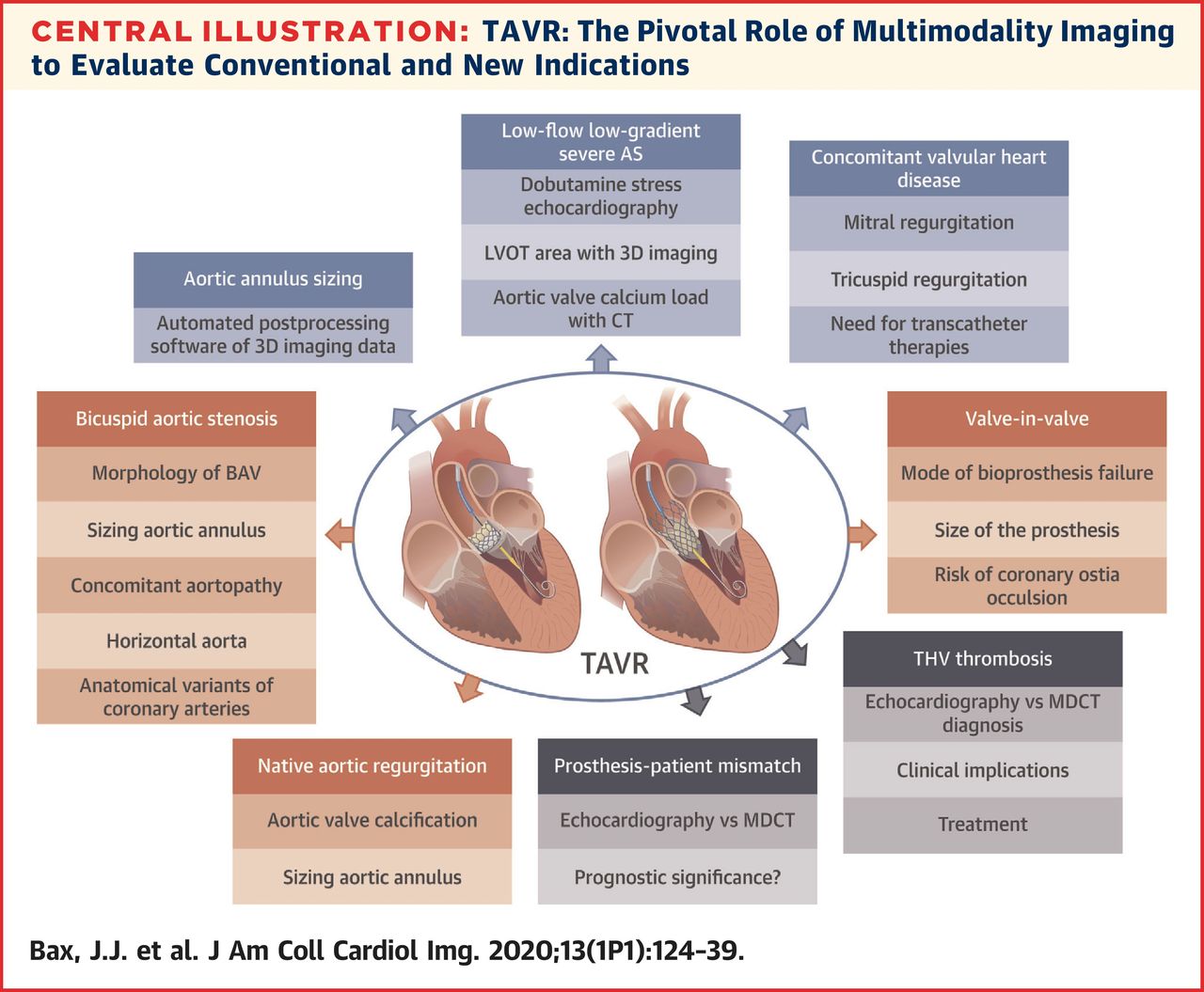
  1. 1. TAVR has rapidly become an established therapy for patients with symptomatic severe aortic stenosis (AS).
  2. 2. Technological advances and the learning curve have resulted in better procedural results in terms of hemodynamic valve performance and intermediate-term clinical outcomes.
  3. 3. The integration of anatomical and functional information provided by multimodality imaging has improved size selection of TAVR prostheses, permitted better patient selection, and provided new insights in the performance of the TAVR prostheses at follow-up.
  4. 4. The use of 3D imaging techniques (multi-detector row computed tomography [MDCT], cardiac magnetic resonance [CMR], and 3D echocardiography) that permit accurate measurement of the left ventricular outflow tract area by direct planimetry has demonstrated the ability to reclassify severe AS patients into moderate AS by 12% in patients with low-flow, low-gradient severe AS.
  5. 5. Furthermore, the field of TAVR continues to develop and expand the technique to younger patients with lower risk on the one hand, and more complex clinical scenarios, on the other hand, such as degenerated aortic bioprostheses, bicuspid aortic valves, or pure native aortic regurgitation.
  6. 6. The use of both echocardiography and MDCT is key in the diagnosis of patients with severe AS who may benefit from TAVR as well as in the procedural planning and evaluation of the results at follow-up.
  7. 7. The number of patients with bicuspid AS treated with TAVR is increasing and the TAVR results with the use of new generation prostheses are promising.
  8. 8. TAVR in degenerated bioprosthesis has been an important recent breakthrough because re-operation in these individuals is associated with very high mortality.
  9. 9. Patients with native aortic regurgitation are also now being treated with TAVR.
  10. 10. These newer indications for TAVR need careful imaging evaluation of the anatomy of the landing zone to ensure successful anchoring of the TAVR prosthesis and to minimize complications. These new horizons for TAVR are making multimodality imaging critically important for this evolving therapy.


































